
Of Trump's reciprocal tariffs and trade deals
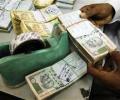
Exporters body FIEO said the slide in rupee, which closed at all-time low of 60.72 against the dollar, was a "serious" matter and asked traders to use derivatives to hedge the currency risk.

The declining exports would have implications for the job market.

The country's exports grew by 47.19 per cent to $35.17 billion on account of healthy growth in the outbound shipments of petroleum, engineering, and gems and jewellery, according to the provisional data of the commerce ministry. Imports during the month also rose by 59.38 per cent to $46.40 billion, leaving a trade deficit of $11.23 billion. Exports of petroleum, engineering, and gems and jewellery in July increased to $3.82 billion, $2.82 billion and $1.95 billion respectively, the data showed.

The importance of China as India's top trading partner cannot be understated.

After recording positive growth in September, India's exports declined 5.4 per cent to $24.82 billion in October on account of dip in shipments of petroleum products, gems and jewellery, leather, and engineering goods. Trade deficit in October narrowed to $8.78 billion as against $11.76 billion, as imports also fell 11.56 per cent to $33.6 billion during the month under review.


The country's exports in December surged 37 per cent on an annual basis to $37.29 billion, the highest-ever monthly figure, government data showed on Monday.

New Delhi, while opting not to retaliate yet to the American tariffs, has in recent weeks sought to reinforce its friendship with Moscow, and recalibrate its ties with Beijing rather than surrender to Washington's diktats.
Exporters on Thursday demanded fiscal incentives, tweaking in customs duties on certain products and credit at affordable rates in the forthcoming Budget to boost exports and create jobs. In a pre-budget virtual meeting with Finance Minister Nirmala Sitharaman, the Federation of Indian Export Organisations (FIEO) said the depreciation of the rupee against the US dollar is affecting exports' competitiveness and the sector requires more support. "Creation of employment is the biggest challenge faced by the country...We would urge the government to provide fiscal support to units which provide additional employment in the export sector," the exporter's body said.

India's exports are unlikely to get an immediate boost from a depreciating rupee, which touched an all-time low on Monday, driven by rising commodity prices. The rupee fell to 76.97 against the dollar earlier in the day, settling 1.05 per cent weaker than the previous close. Oil prices soared to their highest since 2008 on Monday at $139 per barrel, after the US and European allies explored a Russian oil import ban, while delays in the potential return of Iranian crude oil to global markets increased supply fears.
The country's exports rose by 48.34 per cent to $32.5 billion on account of healthy growth in shipments of petroleum products, gems and jewellery, and chemicals, leather and marine goods, according to the data released by the Commerce Ministry on Thursday. Imports in June too rose by 98.31 per cent to $41.87 billion, leaving a trade deficit of $9.37 billion as against a trade surplus of $0.79 billion in the same month last year. During April-June 2021, the exports increased by 85.88 per cent to $95.39 billion.
India's exports jumped 45.76 per cent to $33.28 billion in August on account of healthy growth in segments like engineering, petroleum products, gems and jewellery and chemicals, even as the trade deficit widened to a four-month high of $13.81 billion.
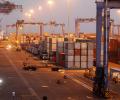
Growing for the third consecutive month, the country's exports rose marginally by 0.67 per cent year-on-year to $27.93 billion in February even as trade deficit widened to $12.62 billion, according to official data released on Monday.

'Obviously, MSP hike raises chances of a reduction in exports. Even without an MSP hike, India's exports of a number of agri-commodities, like sugar, were unviable in the overseas markets.'
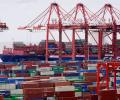
After staging a strong recovery from COVID-induced slowdown in 2021, India's exports are likely to extend the growth story to the New Year also on increased demand in the global markets, boost in domestic manufacturing due to production-linked incentive schemes and implementation of some interim trade pacts. Expectations of positive growth in the country's exports are also backed up by the outlook of the World Trade Organisation (WTO) which predicts a 4.7 per cent expansion in the global merchandise trade volume in 2022. Exporters believe that the outbound shipments would cross $400 billion mark in this fiscal going by the current momentum and may reach $475 billion in 2022-23.
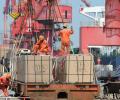
Trade deficit during the month narrowed to USD 14.54 billion from USD 15.3 billion in January 2020. It was USD 15.44 billion in December 2020.
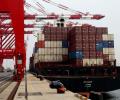
Imports increased by 4.5 per cent, the highest growth in the last six months as crude oil and gold shipments shot up in the month.

Banks and companies in India are taking a cautious approach towards Sri Lanka, which, reeling from a financial crisis, has sought a $1-billion loan from the country to import essential commodities. A senior State Bank of India (SBI) executive said the bank was committed (to Sri Lanka) for the long term. "As far as exposures (are concerned), the bank will be cautious on its dollar exposure to Sri Lankan entities till the situation improves," he said.

The trade deficit marginally narrowed to $12.5 billion last month from $12.8 billion in July.

On the occasion of Chinese president Xi Jinping's two-day visit, Indian exporters are looking for a big boost in export of agricultural commodities, especially the ones that have been impacted by the ongoing trade war between the United States and China.
Sectors, which, recorded healthy export growth included electronics, engineering, chemicals, pharma and tea.

The country's exports dipped 8.74 per cent to $23.52 billion in November on account of contraction in shipments of key sectors like petroleum, engineering, chemicals and gems and jewellery, official data showed on Tuesday. Trade deficit during the month narrowed to $9.87 billion as imports too declined by 13.32 per cent to $33.39 billion.

If the US' renewed closeness with Pakistan ends up strengthening Pakistan's military, it will clearly show that Washington no longer wants a strong India and could be ready to let China dominate Asia, notes Colonel Anil A Athale (retd).

India's exports rose marginally to $27.15 billion in December 2020, while imports surged 7.56 per cent to $42.59 billion, official data showed on Friday. The merchandise exports were valued at $27.11 billion in December 2019 while imports had totalled $39.59 billion.
Imports also fell for the eighth consecutive months, down 0.75 per cent to $41.14 billion in January, widening the trade deficit to a seven-month high of $15.17 billion.
Giving a relief to exporters community, the government on Thursday said it will release Rs 56,027 crore to exporters against pending tax refunds under different incentive schemes for outbound shipments. The amount will be disbursed to more than 45,000 exporters. Briefing the media about the decision, Commerce and Industry Minister Piyush Goyal said that the Rs 56,027 crore, which is being released under various export promotion schemes, is over and above duty remission of Rs 12,454 crore for the Remission of Duties and Taxes on Export Products (RoDTEP) Scheme and Rs 6,946 crore for Rebate of State and Central Levies and Taxes (RoSCTL) Scheme already announced.

Sharma, who has been regularly reviewing the situation with senior officials, has expressed concern over the drop in industrial performance in the recent months, the statement said.

Modi sees export-led growth one of the best ways to create jobs.
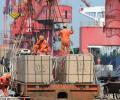
India's exports fell for the fourth straight month in June as shipments of key segments like petroleum and textiles declined but the country's trade turned surplus for the first time in 18 years as imports dropped by a steeper 47.59 per cent.
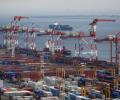
Exports of petroleum products, chemicals, pharmaceuticals, gems and jewellery, and engineering goods registered a positive growth.

The Reserve Bank on Monday asked banks to put in place additional arrangements for export and import transactions in Indian rupees in view of increasing interest of the global trading community in the domestic currency. Before putting in place this mechanism, banks will require prior approval from the Foreign Exchange Department of the Reserve Bank of India (RBI), the central bank said in a circular. "In order to promote growth of global trade with emphasis on exports from India and to support the increasing interest of global trading community in INR, it has been decided to put in place an additional arrangement for invoicing, payment, and settlement of exports / imports in INR," it said.
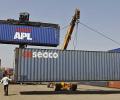
With exporters' claim for over five months still pending, liquidity has been wiped out and the process of finalising new contracts has been held up.
Rising cost of credit and infrastructure bottlenecks are hurting the export sector, says Rafeeque Ahmed, President, Federation of Indian Export Organisations.

Lakhs of jobs are at stake.
Commerce Minister Arun Jaitley will take up with Finance Minister Jaswant Singh the issue of hardening rupee and its impact on exports to ensure that growth is sustained without exporters having to curtail their profit margins.

Contracting for the seventh month in a row, India's exports dipped by 15.82 per cent in June to $22.28 billion due to global slowdown and dip in crude oil prices that impacted shipments of petroleum products.

Exports to Europe shrank by near 2 per cent in the 11 months.
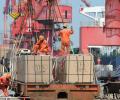
Imports too declined 26 per cent to $29.47 billion in August, leaving a trade deficit of $6.77 billion.
